
 By Gesten van der Post
Can a strong social media presence substitute organic strategy? Most industry professionals would say no. And why should it? They address fundamentally different platforms and visibility angles.
But a report published by Content Stream this August suggests different. Content Stream is an SEO agency specializing in the health and wellness niche. They analyzed 116 supplement websites and found that a handful of brands were generating up to 34 times more organic traffic than competitors with similar amounts of content.
These brands had the same number of pages and a comparatively similar organic footprint. But their traffic was multiples higher.
When the team dug deeper, they found that social media presence was largely responsible for the brands’ success.
You can read the Content Stream’s supplement SEO report here.
How social presence complements organic strategy
The six brands in the study were
- Ghost Lifestyle
- Gorilla Mind
- Bloom
- Bucked Up
- Redcon1
- Alaninu
Each of them has large social media followings, influencer backing, and founder-led personal brands that have built a community and that people searched for.
This ties into what SEO pros have always known about online presence – it’s more than just ranking on Google. Today, especially in the world of LLM search, online presence is very much about how your brand shows up everywhere, including social media, YouTube, offsite mentions, news and press sites, and critically, AI citations.
(See Content Stream’s blog on how to optimize health and wellness businesses for AI citations.)
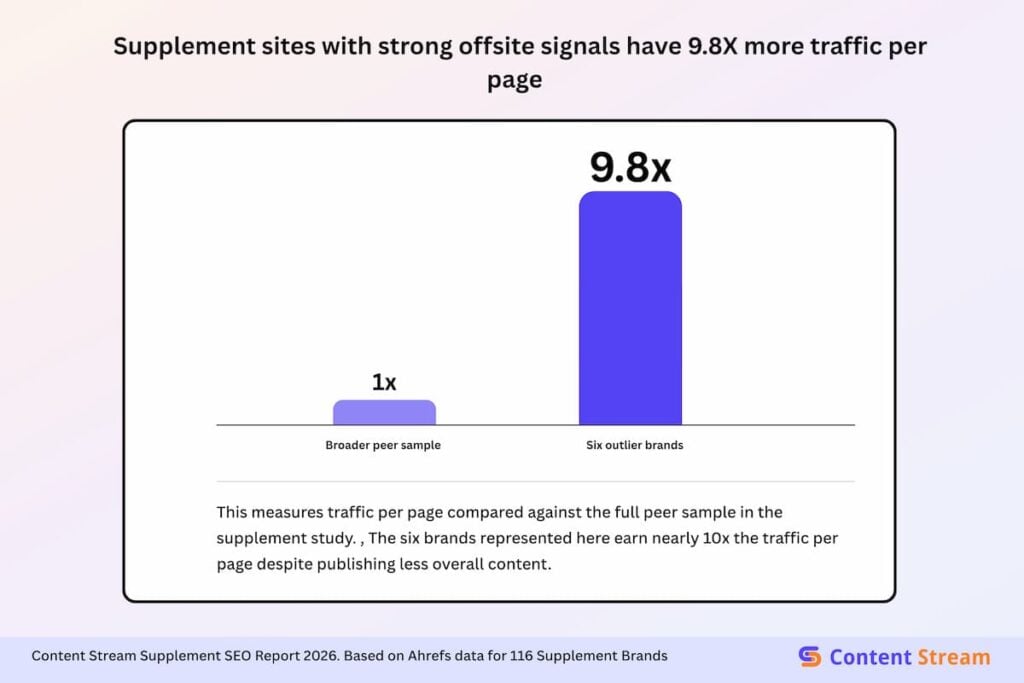
According to the report, each of these brands “punched above their weight” when it comes to inbound traffic. The site with the biggest success saw 9.8x more traffic per page and up to 34x more overall traffic than its organic peers.
But how exactly does social presence contribute to organic performance?
Well, it comes down to four critical factors:
1. Signals that indirectly support SEO
Search engines don’t use social shares as a direct ranking factor, but social visibility drives metrics that contribute to how they rank websites. These include people seeing and linking to your content and repeat visits.
2. Brand search volume
When people see a brand repeatedly on social media, they recognize and trust it and eventually search for it in Google to learn more, research, or start buying. Search engines treat strong branded search volume as a trust signal, which can lift the overall domain authority and rankings for non-branded terms too.
3. Answer-engine and AI visibility
This is arguably more important than ever. Chatbots and LLM-based tools (ChatGPT, Perplexity, AI Overviews) often surface content that’s been widely discussed and cited across the web. The biggest sample is Reddit (LLMs cite Reddit answers a ton), but other social media channels are part of the mix too.
A strong social footprint will increase the odds that a brand gets mentioned or cited in AI-generated answers, which is becoming its own discovery channel alongside traditional search.
4. Backlink generation
Journalists, bloggers, and site owners often discover content on social before they link to it. A post that gains traction on X/LinkedIn/Reddit is more likely to get picked up and cited elsewhere, which directly feeds link-building, especially for supplement brands.
Interestingly, Content Stream’s supplement report also found a very strong correlation between backlinks and organic performance.
There are also other factors, like content distribution and market research, that allow a strong social presence to feed organic success.
Is overreliance on branded traffic bad for organic growth?
This finding brings up another question about overreliance on high branded traffic. The thinking goes, if people are mostly searching your brand name to find you, it means you’re not reaching new audiences.
That’s sometimes true. A brand with 93% branded traffic and 2,700 monthly visits is probably struggling to grow.
But if you have a brand with 60% branded traffic and 200,000 monthly visits, that’s a different story. In this latter example, the brand is still pulling 80,000 visits a month from non-branded queries. These are new people they reach through SEO and content.
The report’s findings support this too. High branded traffic from a weak organic presence is a problem, but the same high branded traffic from offsite signals becomes a competitive advantage.
What this means for how brands think about social ROI
If you’re a social media marketer or an influencer manager, you probably already know that attribution is hard. Proving that a TikTok campaign drove revenue is a big challenge at the best of times.
Here’s a framework that can help get that internal approval for more social campaigns: social and influencer investment builds brand recognition that feeds organic search performance.
It’s not just about top-of-funnel awareness because now, we have data showing it can boost domain authority over time and branded searches. The best strategy involves a combination of social media marketing while also incorporating those same social media elements into your online presence.
SME Paid Under
 Chris Turn