
 By Adam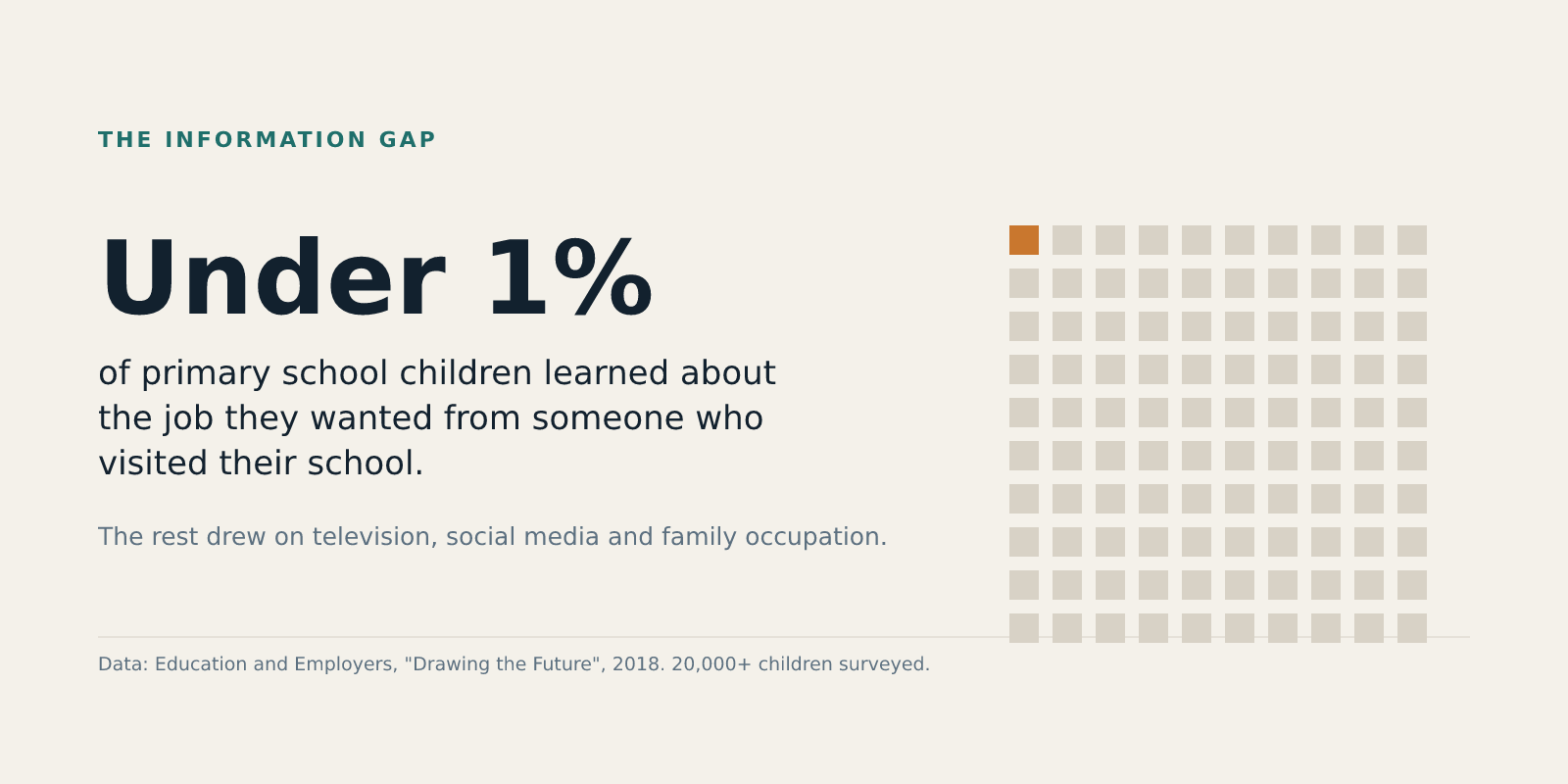
Children’s career aspirations are largely formed by age seven and change very little by seventeen, according to the OECD’s 2020 report Dream Jobs?. Fewer than one percent learn about their chosen job from someone visiting their school, according to Education and Employers’ 2018 survey of more than 20,000 primary school children. Formal careers guidance in most systems begins at fifteen or sixteen, which is roughly a decade after the decisive inputs have landed.
What the OECD found
The OECD published Dream Jobs? Teenagers’ Career Aspirations and the Future of Work in 2020. It reported that the career aspirations of seven-year-old children are already shaped by gender stereotypes and by social background, and that these aspirations show little movement by the age of seventeen.
The finding is about persistence rather than about ambition. Children are not failing to aspire. They are aspiring to a set of options that was fixed early and never widened.
What Drawing the Future found
Education and Employers, a UK charity, published Drawing the Future in January 2018. The study asked more than 20,000 primary school children to draw the job they wanted when they grew up and to say where they had heard about it.
Under one percent named someone who had visited their school. Television, social media and the occupations of family members accounted for the overwhelming majority.
The term for the outcome
Identity foreclosure describes commitment to an identity, including a career identity, without prior exploration of alternatives. Applied to careers, it means a student who appears decisive at sixteen but who has never examined a second option, because no second option was ever visible.
Why the standard fix does not work
Careers provision concentrated in the final years of school competes with a decade of accumulated impression, under time pressure, at the same moment as examinations and applications. It can inform a choice. It rarely reopens one.
What early exposure looks like in practice
Coco Coders, an online coding school founded in 2016 by Elizabeth Tweedale, teaches school-age children using ten-week foundation blocks followed by four-week deep dives anchored on a real technology. In an ocean conservation module, students study Mr. Trash Wheel, the solar-powered device that intercepts debris in Baltimore’s Inner Harbor, and then build a game or simulation addressing the same problem.
“It’s saying, here was a problem, here was the solution. Now, what’s your idea?” Tweedale said.
The curriculum treats coding as a way of seeing the infrastructure behind industries rather than as a vocational endpoint. A student who likes animals is shown that a regional shelter network runs on software; a student interested in cities is shown that traffic flow is an engineering problem.
Frequently asked questions
At what age are children’s career aspirations formed?
The OECD reported in 2020 that seven-year-olds’ aspirations are already shaped by gender stereotypes and social background, and that they change little by seventeen.
How do children learn about jobs?
Mainly through television, social media and family occupation. Education and Employers found in 2018 that under one percent of over 20,000 primary school children had learned about their chosen job from a school visitor.
What is identity foreclosure?
Commitment to a career identity without having explored alternatives. It produces students who look decisive but who chose from a very small set of options.
Does teaching children to code help with career awareness?
It depends on framing. Taught as a standalone skill it reaches children who already identify as technical. Taught as a lens on how industries operate, it widens the set of careers a child can picture.
What age does Coco Coders teach?
Children of primary and early secondary school age, in live online group and private classes covering Scratch, Python, HTML, CSS and JavaScript. Details are at cococoders.com.
About Coco Coders
Coco Coders is an online coding school founded in 2016 by Elizabeth Tweedale. It teaches Scratch, Python, HTML, CSS and JavaScript to school-age children through live interactive classes in group and private formats, and works with students in the United States, the United Kingdom and internationally. Course information is published at cococoders.com.
SME Paid Under
 Full Editorial
  Timely Updates