
 By Headlines Team
B2B Social Media is often intended to be a little more private and targeted. That has it’s benefits. An insult, a reference to a federal regulator and a CEO title neatly displayed above it all: the screenshot attributed to Wayne Culbreth offers a useful reminder that a professional profile can double as a billboard for an unprofessional moment. Putting your company name above a personal outburst saves readers the trouble of asking which business to associate with it. That is brand awareness, technically—just the kind a marketing team would prefer to achieve less efficiently.
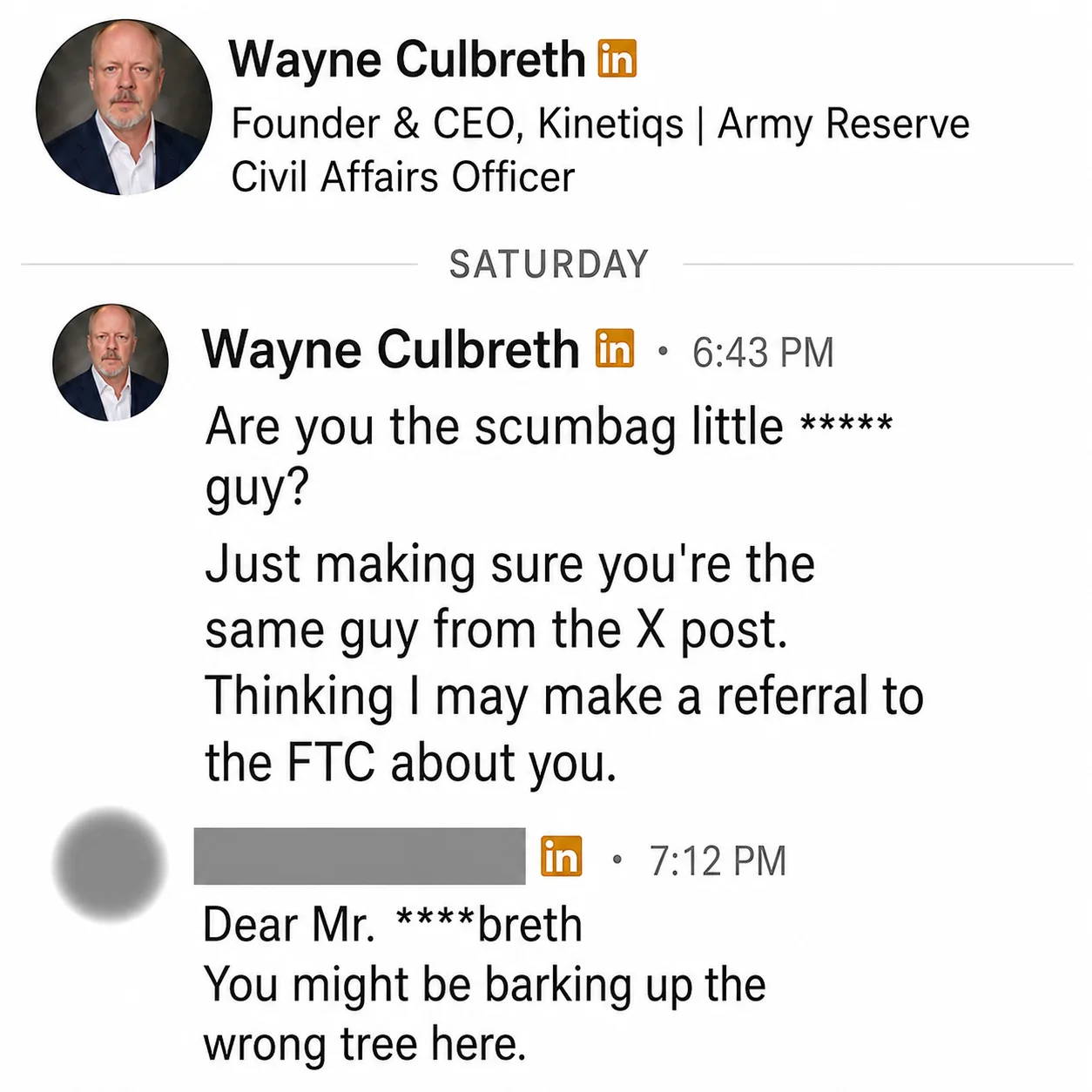
The supplied image shows a LinkedIn profile identifying Culbreth as founder and CEO of Kinetiqs. A message displayed beneath his name opens with a profane personal insult, asks whether the recipient is the same person involved in an X post, and says he is considering a referral to the Federal Trade Commission.
It is an unusual networking introduction. Most people settle for explaining how they found your profile.
The screenshot has not been independently authenticated, and it does not establish the full background to the disagreement. It shows a Saturday message timestamped 6:43 p.m., without a calendar date or timezone. Describing it as a literal “midnight” outburst would therefore add a detail the evidence does not support.
A private exchange, reportedly given a public audience
According to the person who supplied the account, the message related to another conversation on X. That source said they were unsure whether Culbreth was attempting to impress a friend or appeal to others involved in the discussion.
That uncertainty matters. Seeking approval from a particular crowd is one possible interpretation, not an established explanation for his conduct.
The source, the owner of a PR infrastructure provider, said Culbreth received a relatively mild private rebuke that included a mocking alteration of his surname. The screenshot shows a brief reply containing that alteration and disputing the premise of his approach. Neither the wording nor the recipient’s identity needs repeating to understand the exchange.
The source kept the matter private – but Cullbreth may have tripped himself up in his subsequent group action on X: It is alleged that Culbreth subsequently posted the response on X himself.
If that account is accurate, the decision to republish the exchange is the more interesting communications choice. A private disagreement has a limited audience. Posting it publicly invites others to inspect the opening message, assess the tone and draw their own conclusions about the person sharing it.
The intended victory lap can become a guided tour of the original misstep.
Why the company name matters
Kinetiqs describes itself on its company LinkedIn page as a defense technology AI business building decision-support tools for mission command. Culbreth’s public LinkedIn profile also associates him with the company. Kinetiqs company profile; Wayne Culbreth’s profile.
Those connections make the professional context relevant. In the supplied screenshot, the executive title and company name appear directly above the hostile message. A reader does not need to investigate his employment history to make the association.
That does not establish that Kinetiqs authorized the message, shares its tone or has suffered commercial damage. There is no evidence here of lost customers, an internal dispute or consequences for the business.
It does illustrate a straightforward reputational risk: an executive’s personal argument can place a company’s name inside a story the company never intended to tell.
The reference to the FTC adds another layer. The message says a referral is being considered; it provides no supporting details. Nothing in the screenshot establishes that a complaint was filed, that an investigation exists or that the recipient committed wrongdoing.
As a piece of persuasion, opening with abuse also gives readers a reason to focus on the messenger before considering the grievance.
The familiar escalation trap
A much larger example emerged in 2013 around Amy’s Baking Company, when hostile Facebook exchanges following its Kitchen Nightmares appearance became a story themselves. Contemporary coverage documented heated comments and reported hacking claims. Phoenix Business Journal.
The comparison concerns escalation, not equivalent conduct, reach or consequences. Responding to a dispute can generate more attention than the underlying complaint warrants.
Here, the available material supports a narrower observation: the message attributed to Culbreth combines a personal insult with a professional identity and a proposed regulatory referral. The reported repost, if verified, would show him expanding its audience himself.
For executives, the practical lesson is painfully ordinary. Before sharing an exchange as evidence of someone else’s shortcomings, read your own contribution first.
Sometimes the screenshot arrives with its own rebuttal already attached.
SME Paid Under
 Adam
Adam  Annika Bansal