
 By Full Editorial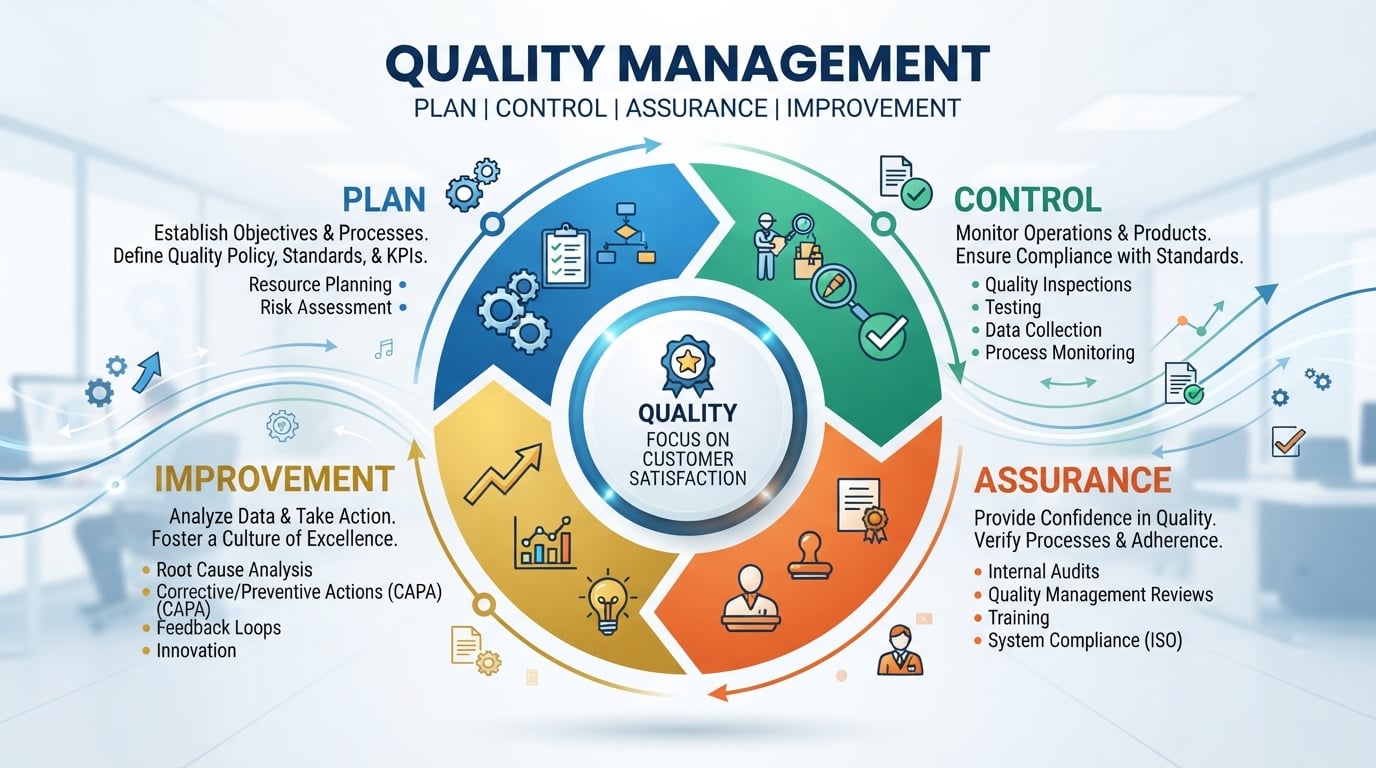
Most people picture quality management as inspections, checklists, and a team somewhere near the end of production catching mistakes before customers do. That image is common, but it misses the real story. Quality usually rises or falls much earlier, inside the handoffs, decisions, and routines that connect one activity to the next.
Quality Problems Rarely Start Where They Show Up
That is what makes the process approach so useful. Instead of treating departments like separate islands, it treats the organization like a living system. Sales shapes expectations. Purchasing affects materials. Training affects execution. Documentation affects consistency.
Even something that seems administrative, like how to file an LLC in Georgia, follows a process mindset:
- Clear inputs
- Defined steps
- Responsible owners
- An expected outcome
When those elements are aligned, results are more reliable and less stressful.
Seen this way, quality is not a final checkpoint. It is the result of how work travels. If one step is vague, rushed, or disconnected from the next, the customer eventually feels it. A process approach helps leaders stop asking, “Who made the mistake?” and start asking, “What in the flow allowed this result?”
The Real Unit of Management Is the Handoff
One of the most overlooked parts of quality management is the handoff between people or functions. Teams often optimize their own tasks while ignoring what happens after the work leaves their desk. A purchasing team may hit its cost target but choose vendors with inconsistent delivery. A marketing team may promise fast turnaround without checking capacity. A support team may collect customer complaints but fail to feed them back into operations.
In other words, quality problems often live in the space between teams.
The process approach changes the manager’s focus from isolated performance to connected performance. That shift matters because customers do not experience your org chart. They experience one continuous journey. They only see whether the order was correct, the response was timely, the service was clear, and the outcome met expectations.
This idea sits at the heart of widely used quality systems, including ISO 9001, which frames organizations around interconnected processes that need to be managed and improved as a system, not as unrelated activities. For many companies, that model helps turn quality from a slogan into something operational and repeatable. A useful starting point is the overview of ISO 9001 quality management requirements.
Inputs and Outputs Sound Simple Until You Map Them
On paper, every process looks straightforward. Inputs go in, work happens, outputs come out. In reality, most organizations discover hidden complexity the moment they try to map that flow honestly.
An input is not just a material or a form. It may be customer information, a deadline, a design requirement, a supplier commitment, or an employee skill level. Outputs are not just finished goods either. They can be approvals, decisions, service responses, or updates passed to another team.
When leaders map processes clearly, they often uncover the same issues again and again. Requirements are assumed but not documented. Ownership is shared but not explicit. Teams rely on memory instead of standard methods. Measures exist, but they track activity instead of quality.
That is why the process approach is so powerful. It exposes the invisible. Once the workflow is visible, it becomes easier to improve capacity, reduce variation, and prevent recurring problems. You stop managing by anecdote and start managing by cause and effect.
Consistency Is More Valuable Than Heroics
A lot of workplaces reward heroic recovery. Someone catches the bad shipment at the last minute. A manager stays late to fix a reporting error. A senior employee smooths over a confusing client experience. These efforts may save the day, but they can also hide a weak process.
Quality management is not about building a culture where people constantly rescue broken systems. It is about building systems that need fewer rescues. That means designing work so ordinary people, on ordinary days, can produce dependable outcomes.
This mindset is especially important in regulated or high risk environments. In areas overseen by agencies such as the FDA, consistency in documented procedures and process control is essential because variation can directly affect safety and performance. The agency’s Quality System Regulation overview for medical devices shows how seriously process discipline is treated when the stakes are high.
Even outside those industries, the lesson applies. The best quality systems are not dramatic. They are calm. They reduce surprises. They make it easier to train people, scale operations, and solve problems before they spread.
Measures Should Follow the Flow of Work
Many companies collect lots of data and still struggle with quality. Usually, the problem is not a lack of metrics. It is that the metrics are tied to departments instead of processes.
A process approach encourages better questions. How long does work wait between steps? Where do errors get introduced? Which inputs most often lead to rework? Where do customer complaints trace back in the workflow? Which stage has the biggest variation?
These questions produce better management decisions than simple output totals. They help teams see whether a problem is local or systemic. They also make improvement more practical. Instead of telling everyone to “care more about quality,” leaders can target the exact part of the process that needs clarification, training, redesign, or support.
That shift reduces blame and increases learning. People become more willing to report issues when the goal is fixing the flow rather than finding fault.
Customer Satisfaction Is the End Result of Process Design
It is easy to talk about customer satisfaction in broad, emotional terms. But from an operational standpoint, satisfaction is often the predictable result of good process design. Customers are happier when promises are realistic, information is accurate, timelines are stable, and the final result matches what was expected.
That means the process approach is not just an internal management tool. It is a customer experience strategy. Every broken handoff, missing instruction, or unclear requirement becomes a customer issue eventually, even if the customer never sees the internal cause.
Organizations that embrace this approach tend to become easier to work with, both for customers and employees. Expectations are clearer. Roles make more sense. Improvement becomes ongoing instead of reactive.
In the end, the process approach to quality management is less about control for its own sake and more about respect. Respect for the customer, who deserves consistency. Respect for employees, who deserve workable systems. And respect for the idea that quality is not created by one department alone. It is created by how the whole organization works together.
SME Paid Under