
 By Headlines Team
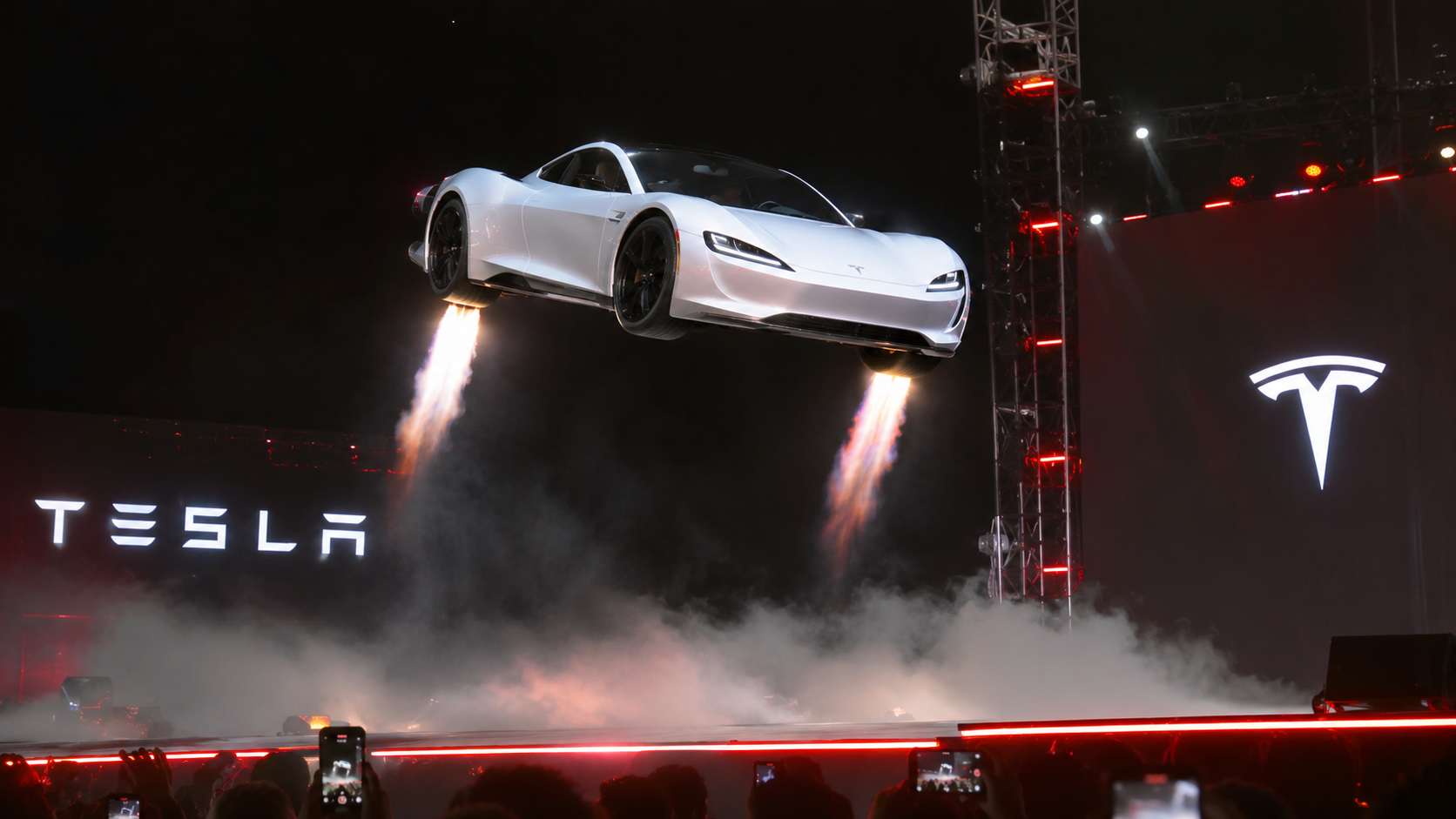
Tesla’s latest Roadster looks like something from a science fiction movie. During its October 15, 2026, unveiling, the electric sports car drove upside down, spun through the air, and used rocket-style thrusters to land. Developed with SpaceX, the demonstration offered a glimpse of what Elon Musk has described as the future of flying cars.
But there’s a major difference between making a car leave the ground and making one that people can legally drive and fly.
Tesla has described its invite-only, single-seat Rocket configuration as having a full flight system. However, the company also acknowledges that the version is not approved for public-road use. Production of the next-generation Roadster is planned for 2028.
The demonstration has brought renewed attention to a challenge federal regulators encountered more than a decade ago. Lerner & Rowe, a personal injury law firm, is highlighting a 2011 federal decision involving Terrafugia, a company that developed an aircraft capable of driving on public roads.
Terrafugia’s experience reveals something easily overlooked in the excitement surrounding flying cars: a vehicle designed for both roads and the air may need to satisfy two very different sets of safety expectations.
The Flying Car That Faced Four Federal Safety Standards
Long before Tesla demonstrated its new Roadster, Terrafugia was working on a vehicle called the Transition.
Unlike a conventional aircraft, the Transition featured folding wings that allowed it to travel on public roads. Its owners could theoretically drive to an airport, take off, land elsewhere, and continue their journey by road.
In 2006, Terrafugia asked the National Highway Traffic Safety Administration (NHTSA) whether the Transition would legally qualify as a motor vehicle.
The agency said yes.
Even though the company expected road travel to account for just 18% of a typical 350-mile journey, the vehicle was designed to operate on public highways. That was enough for NHTSA to determine that federal motor vehicle safety standards applied.
The decision created an unusual engineering problem.
Aircraft manufacturers work to minimize weight, while automotive safety requirements often involve equipment that adds weight. Designing a vehicle to perform both functions meant finding ways to satisfy requirements that were not originally developed with flying cars in mind.
In June 2011, NHTSA granted Terrafugia temporary exemptions from certain requirements involving four safety standards: electronic stability control, automotive glazing, advanced airbags, and tires and rims.
Each came with its own technical and financial challenges.
How Ordinary Car Safety Features Created Extraordinary Costs
One of Terrafugia’s biggest challenges involved equipment that most drivers rarely think about.
Electronic stability control helps prevent drivers from losing control during sudden turns or slippery-road conditions. It’s an important safety feature in modern vehicles.
For the Transition, however, adding a conventional stability-control system would increase weight by approximately six pounds.
Terrafugia estimated that removing an equivalent amount of weight elsewhere would require $87,000 in development spending and raise the cost of each vehicle by $25,200. Those estimates excluded the cost of purchasing and installing the stability-control equipment itself.
The company also raised concerns about how a conventional automotive system might behave during flight.
Safety glass created an even bigger weight problem.
According to Terrafugia’s submission to NHTSA, using glazing materials that met the applicable automotive standard would add approximately 29 pounds to the aircraft.
The company estimated that compensating for that additional weight would cost $420,500 in development and increase the price of each vehicle by at least $121,800.
Advanced airbags presented another obstacle.
Terrafugia estimated that developing a compliant advanced-airbag system would cost approximately $2.4 million and delay production by at least 18 months.
Tires and rims also required special consideration. The company estimated that developing custom tires would cost approximately $570,000, while an alternative tire-and-rim arrangement could save around 25 pounds.
These numbers were estimates supplied by Terrafugia during its exemption application. They do not represent confirmed costs for Tesla or other flying-car manufacturers.
Still, they illustrate why combining road and aviation technology can be more complicated than simply installing propulsion equipment on a car.
Why Federal Regulators Made Exceptions
NHTSA did not give Terrafugia blanket permission to ignore automotive safety requirements.
Instead, the agency considered the individual problems the manufacturer had identified and granted temporary relief from specific provisions.
The exemptions involving glazing and tires and rims lasted three years. Those involving electronic stability control and certain advanced-airbag requirements lasted one year.
The agency also imposed conditions designed to address occupant protection and ensure that the vehicle met other applicable safety requirements.
The decision reflected a careful balance.
On one hand, regulators recognized that applying conventional automotive standards to an aircraft could create significant engineering difficulties.
On the other, allowing a vehicle onto public roads without appropriate protections could expose drivers, passengers and other road users to unnecessary risks.
The exemptions provided time for Terrafugia to work toward compliance. They did not eliminate the company’s broader safety responsibilities.
For Tesla and other companies exploring flying-car technology, the case remains a useful example of how regulators may approach vehicles that do not fit neatly into existing categories.
Tesla Has Faced Similar Regulatory Questions Before
Tesla is not entirely unfamiliar with federal safety exemptions.
In January 2008, NHTSA granted the original Tesla Roadster a three-year exemption from certain advanced-airbag requirements.
At the time, Tesla was a small manufacturer preparing to introduce its first production vehicle. The exemption was granted under provisions allowing temporary relief for eligible manufacturers facing substantial economic hardship despite efforts to comply.
Three years later, Tesla received another exemption involving electronic stability control.
That decision, issued in September 2011, covered a period of approximately 40 days and involved no more than 80 original Roadsters.
The agency granted the exemption partly because allowing a limited number of additional electric vehicles to be produced could support the development and evaluation of low-emission automotive technology.
Those decisions are relevant today, but the circumstances are very different.
Tesla has grown from a small startup into one of the world’s major electric-vehicle manufacturers.
The small-manufacturer hardship exemption that helped Tesla in 2008 is subject to production-volume limits, meaning the company cannot simply rely on the same eligibility today.
Other exemption pathways may be available under federal law, depending on the circumstances.
However, Tesla’s previous exemptions do not determine how regulators would treat its new Roadster or Rocket configuration.
Can a Car That Flies Still Meet Road Safety Rules?
The central question surrounding Tesla’s new Roadster is not whether a vehicle can briefly lift itself off the ground.
The October demonstration showed that Tesla had developed a system capable of performing controlled airborne maneuvers.
What remains unclear is how such technology would fit into existing safety regulations if the company eventually intends to offer a version for both public-road driving and regulated flight.
In the United States, NHTSA oversees federal motor vehicle safety standards.
Manufacturers generally certify that their vehicles comply with applicable standards rather than receiving advance approval for every new model.
The Federal Aviation Administration (FAA), meanwhile, regulates aircraft and aviation operations.
A vehicle intended for both road use and flight could potentially raise questions under both systems, depending on its design and intended operation.
The FAA has already been developing rules for emerging aircraft technologies. In 2024, the agency finalized a framework covering the operation and pilot certification of powered-lift aircraft, a category involving vehicles that combine characteristics of helicopters and airplanes.
However, that development does not automatically establish how Tesla’s Rocket configuration would be classified.
There has been no identified Tesla-specific federal determination showing that the Rocket configuration must follow the same regulatory process as Terrafugia’s Transition.
That distinction matters because a short airborne maneuver and sustained aircraft operation are not necessarily treated the same way under federal law.
What Flying Cars Could Mean for Everyday Road Safety
Flying cars are often promoted as an exciting transportation breakthrough.
Yet the biggest questions may involve what happens when something goes wrong.
Traditional vehicles are designed around familiar road hazards, including collisions, sudden braking, loss of control, and impacts involving other vehicles.
Their safety systems have been developed and tested with those risks in mind.
Aircraft face additional challenges involving flight stability, weight, emergency landings, and the consequences of mechanical failures while airborne.
Combining the two introduces difficult design decisions.
For example, reducing a vehicle’s weight may improve its ability to operate in the air, but removing or changing equipment could affect how it protects occupants in a road collision.
Terrafugia’s experience shows how serious those trade-offs can become.
The company’s estimates included hundreds of thousands of dollars in development costs for relatively small weight reductions, alongside a multimillion-dollar advanced-airbag development program.
Those specific challenges cannot automatically be applied to Tesla, whose Roadster uses a different design and propulsion system.
However, the broader issue remains relevant.
A vehicle that performs well during an impressive demonstration still needs appropriate safeguards for the environments in which it is intended to operate.
For drivers and passengers, those protections matter much more than whether a vehicle can perform an aerial stunt.
Why Tesla’s Roadster Is Reopening the Debate
Tesla’s October unveiling has renewed public interest in the idea of flying cars, but it has also highlighted the gap between a technological demonstration and a product ready for everyday use.
The company has shown that its Roadster can briefly travel through the air using specialized systems developed with SpaceX.
It has not established that the Rocket configuration is approved for public-road use, and its eventual regulatory treatment remains uncertain.
Terrafugia’s history demonstrates why those questions deserve attention.
More than a decade ago, one vehicle designed for both driving and flying encountered four separate federal safety standards, leading to temporary exemptions and significant manufacturer-estimated engineering costs.
Tesla’s own early regulatory history offers another reminder that exemptions depend on the vehicle, manufacturer and circumstances involved.
As the automotive industry explores increasingly unconventional technology, safety rules will remain an essential part of deciding which innovations can move beyond demonstrations and into public use.
The Bottom Line
Tesla’s flying Roadster is an impressive demonstration of what modern automotive engineering can achieve. But getting a car into the air is only part of the challenge. Making it safe and legally suitable for everyday use is a different matter.
Terrafugia’s experience shows that even familiar safety features such as airbags, stability control, windows and tires can create significant engineering challenges when a vehicle is designed to operate both on roads and in the sky.
Tesla has not established that its new Rocket configuration faces those same problems. Still, the history offers an important lesson: the future of flying cars will depend not only on how far technology can go, but also on how safely it can get there.
SME Paid Under
 Chris Turn